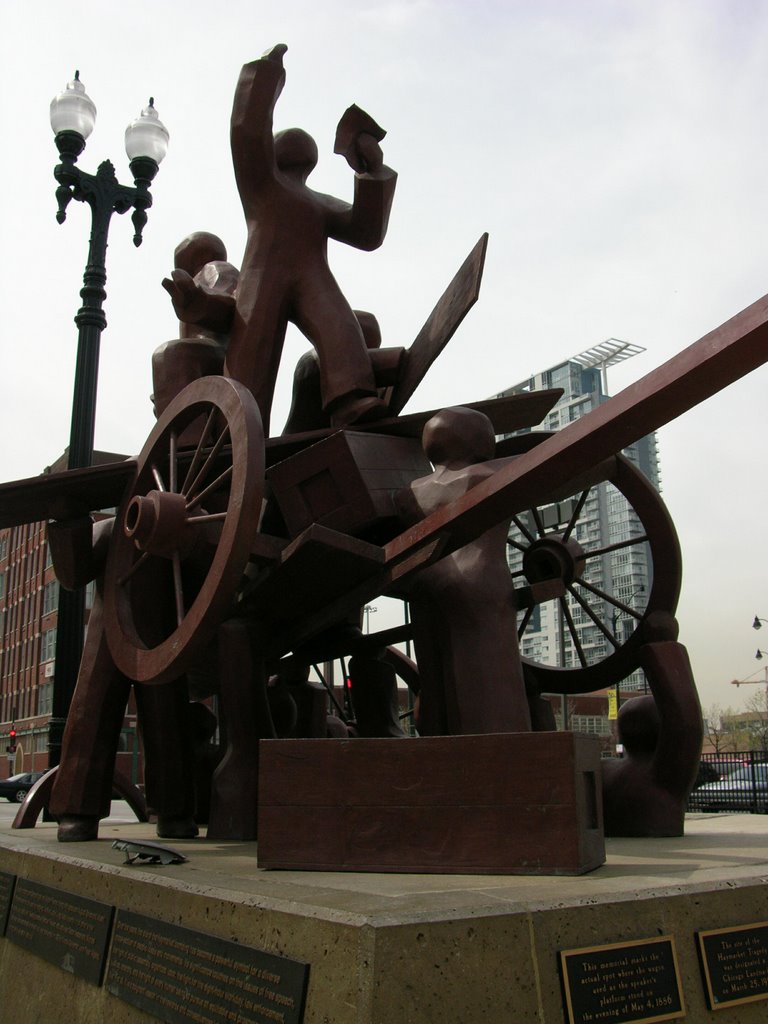
Haymarket Memorial, DesPlaines Street, Chicago
May 4 marks the 122nd anniversary of the Chicago's Haymarket "riot," a police-provoked disturbance at a workers rally for which four innocent men were hung. Two of these four did nothing more than express unpopular political views in public, the other two had no demonstrated connection to provoking the riot leading to the deaths 7 police officers and at least 3 civilians (probably more). Two of the Haymarket martyrs, Albert Parsons and August Spies, were particularly admirable leaders of the Chicago labor/anarchist movement in the 1870s and 1880s that had as its first priority an 8-hour workday (over 30 years before national implementation of the limited work day with overtime requiring heightened compensation), and as its long range vision a society in which members of "self-governing communities and workplaces would determine their own rights and responsibilities democratically, without the domination of a powerful national state with its judges and laws, its police forces and armies." (J. Green, DEATH IN THE MAYMARKET p. 129.)
The event known as the Haymarket riot occurred at a May 4 workers rally, called by local anarchist union leaders in the midst of a series of industry-wide strikes for the 8-hour day and better wages. The featured speaker was Albert Parsons, a confederate officer as a teenager who became a defender of former slaves in Reconstruction Texas before being driven north to Chicago by the retrenching racist elite who could tolerate neither his pro-black political stances nor his marriage to the mixed race Lucy Parsons. In Chicago, Parsons was confronted by the evils of capital's extremist domination and suppression of working people and quickly became a leader of the idealistic movement to organize workers to demand better hours, wages, and, ultimately, a more humanely organized society. For this, Albert Parsons was made a martyr to American evil and became a model of American righteousness.
The day before the Haymarket rally, company thugs had provoked violence among striking workers at the giant McCormick Reaper Works and police then gunned down several strikers. The May 4 rally was called in part to refute bogus police allegations that the workers, and particularly German-language anarchist newspaper publisher August Spies, had provoked the violence. Spies spoke at the Haymarket rally and urged calm in the face of police confrontation. The crowd that night grew as large as 3000. The mayor of Chicago watched the rally for a while from the back of his horse, and then went to a nearby police station where police Inspector Bonfield had amassed a force of officers to counter any violence at the rally. Mayor Harrison told Bonfield that the rally was breaking up and that there was no need to worry about any violence. By this time, as it had started to rain, several of the speakers and organizers, including Parsons (with his wife and two young children), had walked to a tavern a block to the north where they were having a beer and talking about the day's events. Shortly after the mayor rode off toward home, a police agent erroneously told Bonfield that the last speaker, Samuel Fielden, was urging violent action. The trigger happy Inspector ordered the massed force into formation and down the street to the Haymarket, where they came to face the remaining few hundred workers. A police captain called for the rally to disperse peacefully. The speaker Fielden said they were being peaceful. The captain repeated his order to disperse. Fielden said "All right, we will go," and moved to climb down from the speaker's wagon. At that point, someone (probably a lone anarchist worker, but possibly a police agent provocateur) threw a small bomb into the mass of police officers, many of whom immediately began shooting the handguns they had recently begun carrying. Eventually, seven police officers died, one or two from the bomb blast, the rest from bullets fired by other police. (No non-police witnesses saw any of the workers with guns.) The establishment and the "respectable" middle class was of course outraged and terrified; the Haymarket became a symbol of the tenuous control the Establishment classes had over the workers who were suddenly susceptible to utopian visions of a radically different society. This, the establishment could not stand; someone had to pay the price to erase the power of the symbol and the potential power of the democratic majority of worker-citizens.
Despite the acknowledged lack of evidence any of the four martyrs threw the bomb or were involved in any planning for violence or had any advance knowledge of the bomb, they were convicted of conspiracy. The case against Spies and Parsons was basically that they had publicly said the time was coming when striking workers would use force to protect themselves against the increasingly violent attacks by police forces and company hired thugs. Spies and others had romanticized dynamite as a great social leveler, potentially enabling workers to contend with the violence of the bosses and their public and private armies. But there was no substantial evidence Spies ever possessed dynamite or encouraged others to use it. He and Parsons engaged in idealistic, prophetic rhetoric about what would happen if the bosses continued to violently suppress workers organizing and striking to gain better working conditions and wages. For talking about dynamite as a way to resist police suppression, Parsons and Spies were sentenced to die by hanging. Partially in response to an international uproar of the unfairness of the convictions and sentences, the governor indicated he was willing to commute their death sentences to life in prison. But the rules of commutation required the prisoners acknowledge some guilt and plead for mercy and neither Parsons nor Spies was willing to do that. On November 11, 1887, Parsons and Spies were executed, killed, hung from the neck by officials of the State of Illinois.
As a tribute to the memory of the martyrdom of the Chicago anarchists, KDL posts the following passage from the book where this information came, DEATH IN THE HAYMARKET (Pantheon 2006) by labor historian James Green. The point of posting this passage is not to 'nostalgize' about some past idyll that of course never existed, but to evoke the conceptual freedom from a time when workers could envision taking society in a different direction than the one being orchestrated by the big money capitalist overclass. This was the real reason the anarchists had to be killed off: they insisted there was a non-capitalist and better way to organize society, a better way to live life cooperatively, a way that would not enable or allow the kind of super stratified wealth and power a capitalist society requires.
Green writes that in the mid 19th century, white American and European craftsmen "expressed 'a defiant sense of egalitarianism' toward other men who acted as their superiors. Their code was based on a sense of self-worth gained through long apprenticeship and mature workmanship in an honorable trade. They believed their work was noble, even holy, and that they should be regarded romantically as 'knights of labor.' Thus, manly workers refused to be put upon by their bosses or to accept any affront to their dignity. They also opposed efforts to pit themselves against one another. An honorable, respectable working man did not steal from his fellows or seek to undermine their customs and standards by rushing to please the boss or simply to make more money. . . . The habits that craftsmen cultivated were first expressed in the early benevolent societies based on the principle of mutual aid and then in the first craft unions their members called 'brotherhoods.' These 'rituals of mutuality' fused readily with the practices of democratic citizenship that evolved during the nineteenth century among white mechanics and workingmen who came to see themselves as the backbone of the republic.
"Being a skilled tradesman, a competent craftsman and an intelligent citizen required, above all, enlightenment through self-edification. Many craftsmen took pride in the breadth and depth of their reading, and appreciated what they learned from each other on the job. Cigar rollers sometimes asked a literate among them to read a book or newspaper aloud to them while they worked. . . .
"Manufacturers exerted little control over the cigar makers, who worked by the piece, and some producers complained that many of their men would come into the shop in the morning, roll a few stogies and then go to a beer saloon and play cards for a few hours, willfully cutting they day's production and voluntarily limiting their own earnings. These irregular work habits appeared in other trades as well, for instance, among German brewers, who clung to their Old World privilege of drinking free beer while they worked in the breweries. Coopers would appear at work on Saturday morning, like all wage earners did in those years, and then, in some places, they would pool their pay and buy a 'Goose Egg,' a half barrel of beer. 'Little groups of jolly fellows would often sit around upturned barrels playing poker . . .,' wrote a historian of cooperage, 'until they received their pay and the 'Goose Egg' was dry.' After a night out on Saturday and an afternoon of drinking on Sunday, the coopers were not in the best condition to settle down to a regular day's work. They would spend a 'blue Monday' sharpening tools, bringing in supplies and discussing the news of the day.
"Into this world, with its honored traditions, its irregular work habits and its rituals of mutuality came the machine. It rattled on relentlessly 'never tiring, never resting,' . . . dragging the worker along with it. And behind the machine stood a man, an owner or a foreman, who regarded the craftsmen's stubborn old habits and craft union rules as nothing more than ancient customs, relics of medieval times in a modern world governed by the need for industrial efficiency and the unforgiving laws of political economy." (DEATH IN THE HAYMARKET pp. 107-109.)
***
Albert Parsons at his sentencing hearing, October 9, 1886:
"I am doomed by you to suffer an ignominious death because I am an outspoken enemy of coercion, of privilege, or force, of authority. Think you, the people are blind, are asleep, are indifferent? You deceive yourselves. I tell you as a man of the people, and I speak for them, that you every word and act are recorded. You are being weighed in the balance. The people are conscious of your power – your stolen power. I, as a working man, stand here and to your face, in your stronghold of oppression, denounce your crimes against humanity. It is for this I die, but my death will not have been in vain."
We can help ensure Albert Parsons did not die in vain and pay appropriate tribute to Parsons, Spies, and the other worker-visionaries of the nineteenth century by keeping alive an American moral imagination – a vision and eventually practice of a more humane, cooperative society driven not by the imperatives of wealth and social stratification, but by the quest for good, meaningful lives for all.
Let nine thousand flowers bloom.
 RADIO FREE KLAMATH