1.05.2010

Pandora.com and the psychosocial implosion of capitalist modernity

If you are one of the 17 million people with an account at Pandora.com, you know it is a website and internet service that turns your favorite songs into personalized "radio stations" specially tuned to your particular tastes. And you know Pandora is a great way to hear music you like and learn about new musicians and bands you will probably like. And you might be aware that Pandora is at the cutting edge of data-based, web-mediated, hyper-personalized entertainment. And you might even have a feeling, as I do, bubbling up into consciousness, that Pandora is a harbinger of the impending end, the crack-up, the psychological collapse of capitalist modernity as a society and way of life.

Pandora is able to turn your musical preferences into personalized streaming radio stations through use of the Music Genome Project.
The Music Genome Project (MGP) started in 2000 when, according to the Pandora website, "a group of musicians and music-loving technologists came together with the idea of creating the most comprehensive analysis of music ever." The MGP involves analyzing songs by breaking them down into component characteristics descriptive of some feature of the music. In this way, the MGP purports "to capture the essence of music at the most fundamental level," and claims to have done so for the music of tens of thousands of artists.

Pandora was developed by people involved with the Music Genome Project.
After you sign up and type in a favorite song, Pandora accesses the MGP database to determine what characteristics that song has. Pandora then searches the database for other songs with similar clusters of characteristics, and streams those similar songs to you through your internet browser or smart phone, on a special for-you-only "station."

I just called up Pandora on my laptop.
One of six "stations" I have created automatically started up, playing a song I have never heard by a band I like – The Residents. According to the "Song" tab, this song's music genome "characteristics" are: electronics influences, a subtle use of paired vocal harmony, repetitive melodic phrasing, groove based composition, minor key tonality. Three "similar songs" by other bands (two of which I have never heard of) are listed on the side. Notably, you can't tell Pandora what to play – there is no provision for specific requests. You can listen to a sample of any song Pandora has in the database, and there are indeed an astounding amount of them, and start a station based on any of them. (Although searches for a couple of my favorite cutting edge music creators – People Like Us and Ergo Phizmiz – shows they remain below the Pandora radar for now.)

Pandora generates revenue with ads on their web pages, apparently somewhat targeted based on your identified tastes, an occasional audio ad between songs, selling music downloads, and selling premium access.
(Premium access includes no ads, higher quality streams, and access to a Pandora-specific, special-features web application to listen to your stations).

It's hard not to be impressed by Pandora.
You'll most likely hear some music you haven't heard before and you'll probably like quite a bit of it, because it is after all based on your "preferences," defined as the characteristics and clusters of characteristics associated with music you tell Pandora you like. Notably, you might not even recognize the identified "preferences" as things you particularly prefer since most of us have not thought to analyze the music we like into the highly-specific characteristics identified and categorized by the MGP.

This is where Pandora starts to become disconcerting: in a certain way, application of its analytic tool allows Pandora to know you in a slightly more profound way than you understand yourself, and then feed that preference-based image of you back to you.
And at that point Pandora is not only constructing your listening experience, in some sense it is constructing YOU.

Pandora represents a truly advanced form of capitalist consumer culture.
Starting with an analytical breakdown of the particular consumer's particular "preferences," Pandora crafts a super-targeted product – your "stations" or "streams" – that is both based on and aimed at YOU, the only one receiving the experience defined by your particular streams. When you listen to the actual radio, broadcast on electromagnetic waves or through the network of cables and wireless transmissions making up the internet, there is an implied community of people who are hearing the same thing you're hearing at the same time you're hearing it – the "broadcast audience." In this way, radio is a public, social experience, a connection to a temporary community. Even if it is usually fleeting and anonymous, based only on hearing this broadcast at this moment, radio is in fact a social event. Pandora is different. Pandora doesn't broadcast; it provides the narrowest of narrowcasts. The audience is just YOU, which can be further divided into modes of you, with different stations set up for different moods. The Pandora experience is beyond anonymous; it's autonomous. You're the center of attention, but you and Pandora are the only ones there to pay attention. You're off on your own little planet, in your own little bubble of specially-constructed sonic experience, created just for, and presented only to, YOU, based on Pandora's binary analysis and categorization of your "preferences."

And not only that – it's an autonomous little sphere of YOU that is created and 'brought to you' by the global techno-capital infrastructure that builds and manages the universe of experiences defining our contemporary, hypermodern consumer culture society.
I'm not saying Pandora is a totalitarian corporate overlord like Exxon or General Electric or NewsCorp. As far as I can tell, Pandora Media Inc. is a privately held corporation controlled by the people who developed the idea, the kind of company that should be encouraged (along with cooperatives) in a community-centric economy. What I am saying, and what is indisputable to the point of truism, is that the Pandora experience is a paradigm capitalist consumer culture experience.

Ultimately, Pandora's digital techno-construction of consumer experiences in pursuit of profit is not a corporate conspiracy, it is US, and beyond that a glimpse of what we are on the precipice of becoming.

As you listen to Pandora, you are cut off from everybody else, by yourself with your preferences, dependent on the global techno-capital structure for your very own insular, autonomous, self-centered reality.
In this way, Pandora signals the psychosocial cul de sac of capitalist modernity as a way of life and form of self, the end of the road in the burned-out, graffiti-tagged, sub-prime suburb of American consumer culture.

if there were no radios, no tvs, no cd players,
no record players, no tape players, no dvd players,
no mp3 players, and no computers,

people would make their own music


9.14.2009

THREE THINGS COMBINING TO MAKE THE FUTURE OF THE UNITED STATES PROBLEMATIC, AND ARGUING FOR PROGRESSIVES TO PRACTICE THEIR RIGHTS UNDER THE 2ND AMEND.

1) PLUTOCRACY – America has long been run by the wealthy. But over the last 70 years or so that power has been counterweighted by the expansion of the "middle class" tied to the labor movement and the globalization of the economy. But over the last 25 years, post-Reagan, the wealthy have had their power expanded through the rise of the financial sectors of the economy. When capitalism works as intended, money makes money, and when the "Market" was made into a religion that politicians of both parties came to worship, that meant the people with money would make more money and centralize their power. Thus, the immoral gap between the rich and everybody else that has come to characterize American society. While the financial crisis was a bit of a setback for the plutocracy, "Wall Street is back!", meaning the wealthy have reestablished their grip on our economy and all that flows form that. And it could get much worse. Currently the Supreme Court is deciding a case, Citizens United versus the Federal Elections Commission, that conservatives are hoping will overturn all limits on election spending by corporations. Something like 80% of stock wealth (that is, corporations) are owned by less than 10% of the population. If the conservatives have their way, that 10%, through the corporations advancing their interests, will be able to dominate the public space (even more than they already do) and determine who is in and who will win elections. How much plutocracy will the majority of Americans take? With the media dominated by private wealth, will the majority of Americans be able to accurately discern what is going on? How will the media dominated by private wealth seek to divert attention and redirect discontent away from the social arrangements organized to advance the interests of private wealth?

2) SHIFTING DEMOGRAPHICS – The fact is that the white suburban type people who constitute the core of the Republican Party, and the fans of people like Rush Limbaugh, Glenn Beck, and Bill O'Reilly are losing their electoral power at a rate that they will soon not be able to ignore. With the shifting demographics of the US, mostly the increases in people of Hispanic/Latino heritage, the white suburbans are simply losing their ability to control national elections as they have over the last 50 years. When this reality sinks in, many of these people are likely to see it not as the progress of American democracy, but as interlopers stealing "their" country.

3) THE RISE OF UNREASON AMONG WHITE SUBURBAN AMERICANS – The summer of "Tea Parties" and screeching town hall meetings promoted by Glenn Beck and Fox News opened a window onto something serious. Suddenly people who served as cheerleaders for the undermining of the Constitution by the previous president think attempts to bail out the American auto industry and make the health care system more fair are "fascism." This is truly nutty – obviously something else is going on. Obama's policies are not 'all that,' but to call them fascist and socialist and communist is just divorced from reality, just like the insistence that Obama was born in Kenya until he "proves" otherwise. What does it mean that some percentage of Americans can be so far off the mark in their assessment of reality? What does it mean that Glenn Beck, who is either mentally ill or a total charlatan, has become the leader of these people? When these people assert they will "take their country back," they apparently mean they will take it back from the large majority who elected Obama in the last election. In other words, these white suburban Americans believe they have the right to choose who leads America, apparently even when they cannot get a majority of people to agree with them. This belief and the larger inability to engage rationally with reality is a dangerous combination.

8.31.2009

The politics of no meaning among the Beckshirts

After an argument at the Farmer's Market with a guy who loudly proclaimed Obama is a fascist and a communist, I am not naive enough to believe reason or even the meaning of words can influence the emerging right-wing idiocracy. But to help future digital archaeologists clarify the chronology of the Age of Stupid I feel compelled to point out that under any reasonable interpretation of the history and semantics of the words, a person cannot simultaneously be a communist and a fascist. Communism is a dictatorship of the proletariat. Fascism is a dictatorship of corporations. Not the same thing. And for people willing to acknowledge there is such a thing as history, communists and fascists were always mortal enemies.

8.29.2009

Storm on the horizon

The view from Alamo Square, San Francisco

So, the pro-plutocrat faction on the Roberts Supreme Court is apparently looking to use the case described here (Citizens United v. Federal Elections Commission) to make the ultimate ruling: The Constitution of the United States offers no democratic protection against plutocracy. In other words, as the supporters of the plaintiffs in this case would have it, the Constitution allows wealth to govern our country without interference from the governed masses, as represented by Congress -- the law requires us to shut up and take it. If this does indeed go down the "conservative" way, resulting in a political system where corporations can spend unlimited amounts of money to influence elections, democracy in America is dead. We will have reached a point where our "Form of Government becomes destructive of [the democratic] ends" for which this nation was founded, at which point "it is the Right of the People to alter or to abolish [that Government], and to institute new Government, laying its foundation on such principles and organizing its powers in such form, as to them shall seem most likely to effect their Safety and Happiness." Such a situation will obviously make for troubled times as some significant percentage of us (those who believe in the democratic values animating the creation of this nation) will refuse to live on our knees.

8.27.2009

Healthcare reform and the ongoing doltification of America

Nowhere fast -- Humboldt Bay, Eureka, California

The center-right of USAmerican politics is at it again – trying to protect the interests of the plutocratic ruling class through the doltification of the public discourse. The primary mantra against any REAL reform of America's healthcare system, which would necessarily include some kind of public plan that does not depend on the profiteering that mars our current system, is that we need "COMPETITION" and that a public plan would undermine "COMPETITION" by competing the profiteering healthcare corporations out of existence. The center-right liars and/or dimwits (there are, of course, both, and it's not necessarily easy to tell which blow-dried helmet head falls into which category) insist that it's "COMPETITION" that made our current system "the best in the world" and that any strong non-profit option that undermines the profiteers will thereby threaten our "best in the world" system. Of course, we Americans do not have the best healthcare in the world. The World Health Organization lists us at number 36. In other words, somehow the "COMPETITION" the center-right wants to protect does not actually deliver high quality health care to society at large. (It can deliver high quality healthcare to the top 10% or so of the wealth-holders, but serving well 1 out of 10 does not equal a high quality system, as the miserable WHO ranking shows.)

But the real point is that the "COMPETITION" among the profiteers the center-right wants to defend is not competition to provide better health care to more people. (That needs to be said over and over and over: it is NOT competition to provide better healthcare to more people.) The "COMPETITION" they engage in is competition to increase their profits so that their shareholders get a higher return on investment.
That is the "COMPETITION" of the "FREE MARKET." And when it comes to healthcare, that means insuring as few sick people as possible, never covering "pre-existing conditions," and finding creative ways to dump insured people who actually need to use the insurance they've been paying for. In other words, the "COMPETITION" among the healthcare profiteers -- the "COMPETITION" championed by Republicans and centrist Democrats -- is competition to avoid providing the healthcare people pay for! That is why they cannot tolerate a non-profit healthcare option – because in order to "compete" the healthcare profiteers will actually have to make healthcare a priority, which will cut into profits, the generation of which is their sole reason for existing.

This is not to say that the Obama administration and the center-left Democrats have the key to a decent healthcare system.
At best, that remains to be seen. But at least they are not proceeding by shrieking, misinforming scare tactics designed to protect the interests of those who already have the most power.

8.13.2009

Experience and/of/through light

Normal everyday experience is spatiotemporal

Spatiotemporal experience is possible by virtue of light

The character/quality of our experience is to some degree
the character/quality of spacetime, an experience possible by virtue of light

The nature of human experience is rooted in a relation to light

Perhaps not surprisingly, our understanding of light is poor

('Not surprisingly' because the things that are closest,
embedded in everything we do, become so 'natural' as to be invisible.)


The poor state of our understanding of light is manifest in the physicist's conception,
which requires light be both a particle and a wave,
two things that - by definition - cannot be the same thing

We need new thinking about light, a new language of light,
a language that will, ineluctably, alter our experience of spacetime


Rocky Point canoe trail, Upper Klamath Lake

8.01.2009

Deprogramming capitalist temporality -- the 20 Hour Day


Temporality -- the way people exist in time -- is one of the basic frameworks of human reality. Particular temporalities are constituted by particular societies (or, more accurately, sociocultural systems). In other words, the ways a person experiences and practices time will depend on the ways their society constructs time. And just as the continuing existence of society depends on us continually doing 'society' in our everyday lives, temporality does as well – time, like society, is something we actually *do*, and therefore, if we get a good handle on it, it is something we can do differently.

Thus, the way we practice/enact time should be a prominent issue in the democratic discussion of how we should govern ourselves, how we want to organize our societies and everyday lives. For instance, I would advocate, within this politics of time, that a good society will strive to maximize the amount of FREE TIME its members have.

We here in modern Euroamerica practice time the particular way we do *because* it works effectively for capital accumulation. We have and live a hyper-rationalized time where a difference of 1 out of the 1440 minutes that occur every day can make a real difference in a person's life – no wonder we're so stressed out!
(For a bit more more on "capitalist time" and its discontents, see "Boo to Captain Clock.")

My idea is that part of a process of deprogramming ourselves from our corporate capitalist consumer culture is to begin shifting our way of being in time, finding a temporality that is more humanely paced, which is to say, tuned to the rhythm of a democratically-governed everyday life rather than the needs of plutocratic global capital accumulation.

In that spirit, I humbly propose for democratic discussion -- the 20-HOUR DAY.
I propose we endeavor to begin reorganizing our temporality in a more relaxed, enjoyable, humane way by adopting a whole new clock -- a clock that only goes to 10 twice a day (rather than 12), with fifty minutes in an hour and fifty seconds in a minute. Doing the math shows that one second in 'new time' would last for 1.728 seconds in 'old time.' Theoretically, this slower second/minute/hour would eventually structure a more relaxed everyday life. (To help us get there, I would further propose that our 10-hour clocks have no minute marks and no minute hand.) Part of the system could also be that the typical work day is 5 'new hours' (1/4 of the day, so the equivalent of 6 old hours), so that people have more free time. Over time we could try to make the work day even fewer hours so people could have more time to do whatever they enjoy doing when not pressed for time...

7.31.2009

Social value -- democracy versus "the market"

skylight

Since value – how much a thing or activity is worth – necessarily involves social relations, a democratic society has the right to determine value. A democratic society has the right to say that people doing certain kinds of work are particularly valuable or not. A democratic society has the right to say some people will not make thousands of times more money than other people, that no one can be that much more valuable than another to our society, and as a democratic society, we can insist on the right to define our values. There are limits under the Constitution, but they do not encompass anything like capitalism or corporate orchestrated consumer culture. No matter what right wing pundits try to tell you, capitalism and democracy are not the same thing. These right wing opinion leaders desire a society in which there is an elite minority defined by the capital overclass that gets to control everything. They believe that the Constitution defines a society in which there will necessarily be an elite market-based minority. They believe democracy is limited by that basic structure. But there's nothing in the Constitution to which they can point to refute our insistence on democracy, and particularly a democracy of social value. We as a democratic society insist upon the right to define social value, to have thoughtful participation in developing ideas of what is a good life and how we can organize society to best attain it. Conservatives, and capitalists in particular, have to say, at least subtly, that this is the best of all possible worlds or at least that we are on the most direct route to the best of all possible worlds through the capitalist process of commodification. This is an excellent point for debate and public discussion, because it will quickly have the conservatives and the people in power on their heels, and probably reverting to arguments that are basically threats, which would not be surprising because true democracy would undoubtedly threaten their positions of authority and their lives of luxury.

7.29.2009

Arcata Marsh

Arcata, California, is an incredible little city on the Lost Coast in Humboldt County. Among their progressive practices is Arcata Marsh, a reclaimed marsh and wildlife sanctuary that also serves as the city's wastewater treatment plant.


Along the trails of the
Arcata Wastewater Treatment Plant and Wildlife Sanctuary


2.02.2009

from "The Abolition of Work"

Shane's pond, New Orleans

"The official line is that we all have rights and live in a democracy. Other unfortunates who aren't free like we are have to live in police states. These victims obey orders or else, no matter how arbitrary. The authorities keep them under regular surveillance. State bureaucrats control even the smaller details of everyday life. The officials who push them around are answerable only to higher-ups, public or private. Either way, dissent and disobedience are punished. Informers report regularly to the authorities. All this is supposed to be a very bad thing.

"And so it is, although it is nothing but a description of the modern workplace. The liberals and conservatives and Libertarians who lament totalitarianism are phonies and hypocrites. There is more freedom in any moderately de-Stalinized dictatorship than there is in the ordinary American workplace. You find the same sort of hierarchy and discipline in an office or factory as you do in a prison or a monastery. In fact, as Foucault and others have shown, prisons and factories came in at about the same time, and their operators consciously borrowed from each other's control techniques. A worker is a part-time slave. The boss says when to show up, when to leave, and what to do in the meantime. He tells you how much work to do and how fast. He is free to carry his control to humiliating extremes, regulating, if he feels like it, the clothes you wear or how often you go to the bathroom. With a few exceptions he can fire you for any reason, or no reason. He has you spied on by snitches and supervisors, he amasses a dossier on every employee. Talking back is called "insubordination," just as if a worker is a naughty child, and it not only gets you fired, it disqualifies you for unemployment compensation. Without necessarily endorsing it for them either, it is noteworthy that children at home and in school receive much the same treatment, justified in their case by their supposed immaturity. What does this say about their parents and teachers who work?"

Bob Black
, "The Abolition of Work"

12.11.2008

A graphical representation of Sino-American economic relations during the coming period

(mini white guy endeavoring to exhort semi-indifferent Chinese giant)
[click for bigger, more dramatic version]

11.13.2008

RADIO FREE KLAMATH 14.8

RADIO FREE KLAMATH
transmission 14.8
STRANGE NEW LAND
radiowaved on the
frequency modulation band
November 13, 008,
7-9pm
--------------------------------
on
K T E C * 89.5 fm Klamath Falls, Oregon

OIT's freeform station for the Klamath Basin

*** *** ***
CLICK HERE
to open a page where you can
play or download the show
*****************
download
PLAYLIST
*** *** ***

11.06.2008

RADIO FREE KLAMATH 13.8

RADIO FREE KLAMATH
transmission 13.8
atmospheric broadcast on the
frequency modulation band
November 6, 008,
7-9pm
--------------------------------
on
K T E C * 89.5 fm Klamath Falls, Oregon

OIT's freeform station for the Klamath Basin

*** *** ***
CLICK HERE
to open a page where you can
play or download the show
*****************
download
PLAYLIST
*** *** ***

10.24.2008

RADIO FREE KLAMATH 12.8

RADIO FREE KLAMATH
transmission 12.8
radiowaved on the
frequency modulation band
October 23, 008,
7-9pm
--------------------------------
on
K T E C * 89.5 fm Klamath Falls, Oregon
OIT's freeform station for the Klamath Basin

*** *** ***
CLICK HERE
to open a page where you can
play or download the show
*****************
download
PLAYLIST
*** *** ***

10.09.2008

RADIO FREE KLAMATH 11.8

RADIO FREE KLAMATH
transmission 11.8
radiowaved on
October 9, 008,
7-9pm
--------------------------------
on
K T E C * 89.5 fm Klamath Falls, Oregon
OIT's freeform station for the Klamath Basin

*** *** ***
CLICK HERE
to open a page where you can
play or download the show
*****************
download
PLAYLIST
*** *** ***

10.02.2008

RADIO FREE KLAMATH 10.8

RADIO FREE KLAMATH
transmission 10.8
atmospheric-electromagnetic
broadcast on
October 2, 008,
7:30-9:30pm
--------------------------------
on
K T E C * 89.5 fm Klamath Falls, Oregon
OIT's freeform station for the Klamath Basin

*** *** ***
CLICK HERE
to open a page where you can
play or download the show
*****************
download
PLAYLIST
*** *** ***

9.26.2008

RADIO FREE KLAMATH 9.8

RADIO FREE KLAMATH
transmission 9.8
radio broadcast on
September 25, 008,
7-9pm
--------------------------------
on
K T E C * 89.5 fm Klamath Falls, Oregon
OIT's freeform station for the Klamath Basin
*** *** ***
CLICK HERE
to open a page where you can
play or download the show
*****************
download
PLAYLIST
*** *** ***

9.18.2008

WHITE HOUSE REDUX / the democracy demanded by free people

The Storefront for Art & Architecture in NYC held an architectural competition to redesign the White House for the 21st century -- WHITE HOUSE REDUX. Here is KDL's (nonwinning) entry. The third panel was included in the exhibition at the Storefront and the White House Redux book.

[click for legible version]

9.05.2008

RADIO FREE KLAMATH 8.8

RADIO FREE KLAMATH
opportunity/crisis transmission 2.4.8 [8.8]
radiowaved on the frequency modulation band
September 4, 008,
8-10pm
--------------------------------
on
K T E C * 89.5 fm Klamath Falls, Oregon
OIT's freeform station for the Klamath Basin

*** *** ***
CLICK HERE
to open a page where you can
play or download the show
*****************
download
PLAYLIST here
*** *** ***

8.23.2008

RADIO FREE KLAMATH 7.8

RADIO FREE KLAMATH
opportunity/crisis transmission 2.3.8 [7.8]
radiowaved on the frequency modulation band
August 21, 008,
8-10pm
--------------------------------
on
K T E C * 89.5 fm Klamath Falls, Oregon
OIT's freeform station for the Klamath Basin

*** *** ***
CLICK HERE
to open a page where you can
play or download the show
*****************
download
PLAYLIST here
*** *** ***

RADIO FREE KLAMATH 6.8

RADIO FREE KLAMATH
opportunity/crisis transmission 2.2.8 [6.8]
radiowaved on the frequency modulation band
August 14, 008,
8-10pm
------------------------
on
K T E C * 89.5 fm Klamath Falls, Oregon
OIT's freeform station for the Klamath Basin

*** *** ***
CLICK HERE
to open a page where you can
play or download the show
*****************
download
PLAYLIST here
*** *** ***

RADIO FREE KLAMATH 5.8

RADIO FREE KLAMATH
threnody transmission 1.8 [5.8]
radiowaved on the frequency modulation band
August 6, 008,
8-10pm
------------------------
including "Threnody for the Victims of Hiroshima,"
a piece for 52 strings by Krzysztof Penderecki
in memory of the 63rd anniversary of the
U.S. nuclear attack on Hiroshima, Japan,
killing 70,000 (!!!) people on that day
and another 70,000 by the end of the year
----------------------------------------
on
K T E C * 89.5 fm Klamath Falls, Oregon
OIT's freeform station for the Klamath Basin

*** *** ***
CLICK HERE
to open a page where you can
play or download the show
*****************
download
PLAYLIST here
*** *** ***

6.12.2008

RADIO FREE KLAMATH 4.8

RADIO FREE KLAMATH
opportunity/crisis transmission 2.1.8 [4.8]
radiowaved on the frequency modulation band
June 11, 008,
8-10pm
on
K T E C * 89.5 fm Klamath Falls, Oregon
OIT's freeform station for the Klamath Basin

*** *** ***
CLICK HERE
to open a page where you can
play or download the show
*****************
download
PLAYLIST
here

*** *** ***

6.05.2008

RADIO FREE KLAMATH 3.8

RADIO FREE KLAMATH
wartime transmission 3.8
electromagnetic spectrum broadcast June 4, 008, 8-10pm
on
K T E C * 89.5 fm Klamath Falls, Oregon
OIT's freeform station for the Klamath Basin

*** *** ***
CLICK HERE
to open a page where you can
play or download the show
****************
download
PLAYLIST
here
*** *** ***

5.28.2008

RADIO FREE KLAMATH 2.8

RADIO FREE KLAMATH
wartime transmission 2.8
electromagnetic spectrum broadcast May 28, 008, 8-10pm
on
K T E C * 89.5 fm Klamath Falls, Oregon
OIT's freeform station for the Klamath Basin

*** *** ***
CLICK HERE
to open a page where you can
play or download the show
******
download
PLAYLIST
HERE
*** *** ***

5.04.2008

Tribute to the Martyrs of the Haymarket


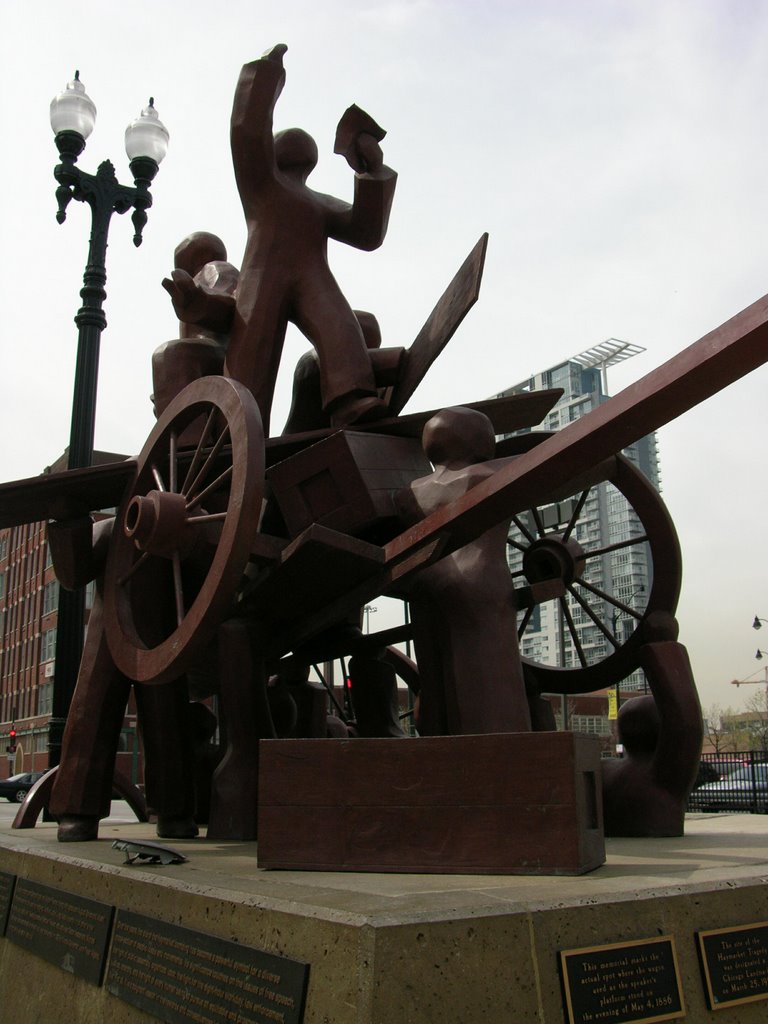
Haymarket Memorial, DesPlaines Street, Chicago

May 4 marks the 122nd anniversary of the Chicago's Haymarket "riot," a police-provoked disturbance at a workers rally for which four innocent men were hung. Two of these four did nothing more than express unpopular political views in public, the other two had no demonstrated connection to provoking the riot leading to the deaths 7 police officers and at least 3 civilians (probably more). Two of the Haymarket martyrs, Albert Parsons and August Spies, were particularly admirable leaders of the Chicago labor/anarchist movement in the 1870s and 1880s that had as its first priority an 8-hour workday (over 30 years before national implementation of the limited work day with overtime requiring heightened compensation), and as its long range vision a society in which members of "self-governing communities and workplaces would determine their own rights and responsibilities democratically, without the domination of a powerful national state with its judges and laws, its police forces and armies." (J. Green, DEATH IN THE MAYMARKET p. 129.)

The event known as the Haymarket riot occurred at a May 4 workers rally, called by local anarchist union leaders in the midst of a series of industry-wide strikes for the 8-hour day and better wages. The featured speaker was Albert Parsons, a confederate officer as a teenager who became a defender of former slaves in Reconstruction Texas before being driven north to Chicago by the retrenching racist elite who could tolerate neither his pro-black political stances nor his marriage to the mixed race Lucy Parsons. In Chicago, Parsons was confronted by the evils of capital's extremist domination and suppression of working people and quickly became a leader of the idealistic movement to organize workers to demand better hours, wages, and, ultimately, a more humanely organized society. For this, Albert Parsons was made a martyr to American evil and became a model of American righteousness.

The day before the Haymarket rally, company thugs had provoked violence among striking workers at the giant McCormick Reaper Works and police then gunned down several strikers. The May 4 rally was called in part to refute bogus police allegations that the workers, and particularly German-language anarchist newspaper publisher August Spies, had provoked the violence. Spies spoke at the Haymarket rally and urged calm in the face of police confrontation. The crowd that night grew as large as 3000. The mayor of Chicago watched the rally for a while from the back of his horse, and then went to a nearby police station where police Inspector Bonfield had amassed a force of officers to counter any violence at the rally. Mayor Harrison told Bonfield that the rally was breaking up and that there was no need to worry about any violence. By this time, as it had started to rain, several of the speakers and organizers, including Parsons (with his wife and two young children), had walked to a tavern a block to the north where they were having a beer and talking about the day's events. Shortly after the mayor rode off toward home, a police agent erroneously told Bonfield that the last speaker, Samuel Fielden, was urging violent action. The trigger happy Inspector ordered the massed force into formation and down the street to the Haymarket, where they came to face the remaining few hundred workers. A police captain called for the rally to disperse peacefully. The speaker Fielden said they were being peaceful. The captain repeated his order to disperse. Fielden said "All right, we will go," and moved to climb down from the speaker's wagon. At that point, someone (probably a lone anarchist worker, but possibly a police agent provocateur) threw a small bomb into the mass of police officers, many of whom immediately began shooting the handguns they had recently begun carrying. Eventually, seven police officers died, one or two from the bomb blast, the rest from bullets fired by other police. (No non-police witnesses saw any of the workers with guns.) The establishment and the "respectable" middle class was of course outraged and terrified; the Haymarket became a symbol of the tenuous control the Establishment classes had over the workers who were suddenly susceptible to utopian visions of a radically different society. This, the establishment could not stand; someone had to pay the price to erase the power of the symbol and the potential power of the democratic majority of worker-citizens.

Despite the acknowledged lack of evidence any of the four martyrs threw the bomb or were involved in any planning for violence or had any advance knowledge of the bomb, they were convicted of conspiracy. The case against Spies and Parsons was basically that they had publicly said the time was coming when striking workers would use force to protect themselves against the increasingly violent attacks by police forces and company hired thugs. Spies and others had romanticized dynamite as a great social leveler, potentially enabling workers to contend with the violence of the bosses and their public and private armies. But there was no substantial evidence Spies ever possessed dynamite or encouraged others to use it. He and Parsons engaged in idealistic, prophetic rhetoric about what would happen if the bosses continued to violently suppress workers organizing and striking to gain better working conditions and wages. For talking about dynamite as a way to resist police suppression, Parsons and Spies were sentenced to die by hanging. Partially in response to an international uproar of the unfairness of the convictions and sentences, the governor indicated he was willing to commute their death sentences to life in prison. But the rules of commutation required the prisoners acknowledge some guilt and plead for mercy and neither Parsons nor Spies was willing to do that. On November 11, 1887, Parsons and Spies were executed, killed, hung from the neck by officials of the State of Illinois.

As a tribute to the memory of the martyrdom of the Chicago anarchists, KDL posts the following passage from the book where this information came, DEATH IN THE HAYMARKET (Pantheon 2006) by labor historian James Green. The point of posting this passage is not to 'nostalgize' about some past idyll that of course never existed, but to evoke the conceptual freedom from a time when workers could envision taking society in a different direction than the one being orchestrated by the big money capitalist overclass. This was the real reason the anarchists had to be killed off: they insisted there was a non-capitalist and better way to organize society, a better way to live life cooperatively, a way that would not enable or allow the kind of super stratified wealth and power a capitalist society requires.

Green writes that in the mid 19th century, white American and European craftsmen "expressed 'a defiant sense of egalitarianism' toward other men who acted as their superiors. Their code was based on a sense of self-worth gained through long apprenticeship and mature workmanship in an honorable trade. They believed their work was noble, even holy, and that they should be regarded romantically as 'knights of labor.' Thus, manly workers refused to be put upon by their bosses or to accept any affront to their dignity. They also opposed efforts to pit themselves against one another. An honorable, respectable working man did not steal from his fellows or seek to undermine their customs and standards by rushing to please the boss or simply to make more money. . . . The habits that craftsmen cultivated were first expressed in the early benevolent societies based on the principle of mutual aid and then in the first craft unions their members called 'brotherhoods.' These 'rituals of mutuality' fused readily with the practices of democratic citizenship that evolved during the nineteenth century among white mechanics and workingmen who came to see themselves as the backbone of the republic.

"Being a skilled tradesman, a competent craftsman and an intelligent citizen required, above all, enlightenment through self-edification. Many craftsmen took pride in the breadth and depth of their reading, and appreciated what they learned from each other on the job. Cigar rollers sometimes asked a literate among them to read a book or newspaper aloud to them while they worked. . . .

"Manufacturers exerted little control over the cigar makers, who worked by the piece, and some producers complained that many of their men would come into the shop in the morning, roll a few stogies and then go to a beer saloon and play cards for a few hours, willfully cutting they day's production and voluntarily limiting their own earnings. These irregular work habits appeared in other trades as well, for instance, among German brewers, who clung to their Old World privilege of drinking free beer while they worked in the breweries. Coopers would appear at work on Saturday morning, like all wage earners did in those years, and then, in some places, they would pool their pay and buy a 'Goose Egg,' a half barrel of beer. 'Little groups of jolly fellows would often sit around upturned barrels playing poker . . .,' wrote a historian of cooperage, 'until they received their pay and the 'Goose Egg' was dry.' After a night out on Saturday and an afternoon of drinking on Sunday, the coopers were not in the best condition to settle down to a regular day's work. They would spend a 'blue Monday' sharpening tools, bringing in supplies and discussing the news of the day.

"Into this world, with its honored traditions, its irregular work habits and its rituals of mutuality came the machine. It rattled on relentlessly 'never tiring, never resting,' . . . dragging the worker along with it. And behind the machine stood a man, an owner or a foreman, who regarded the craftsmen's stubborn old habits and craft union rules as nothing more than ancient customs, relics of medieval times in a modern world governed by the need for industrial efficiency and the unforgiving laws of political economy." (DEATH IN THE HAYMARKET pp. 107-109.)

***

Albert Parsons at his sentencing hearing, October 9, 1886:
"I am doomed by you to suffer an ignominious death because I am an outspoken enemy of coercion, of privilege, or force, of authority. Think you, the people are blind, are asleep, are indifferent? You deceive yourselves. I tell you as a man of the people, and I speak for them, that you every word and act are recorded. You are being weighed in the balance. The people are conscious of your power – your stolen power. I, as a working man, stand here and to your face, in your stronghold of oppression, denounce your crimes against humanity. It is for this I die, but my death will not have been in vain."

We can help ensure Albert Parsons did not die in vain and pay appropriate tribute to Parsons, Spies, and the other worker-visionaries of the nineteenth century by keeping alive an American moral imagination – a vision and eventually practice of a more humane, cooperative society driven not by the imperatives of wealth and social stratification, but by the quest for good, meaningful lives for all.

Let nine thousand flowers bloom.